Chinese Rice Cake Soup年糕汤nián gāo tāng

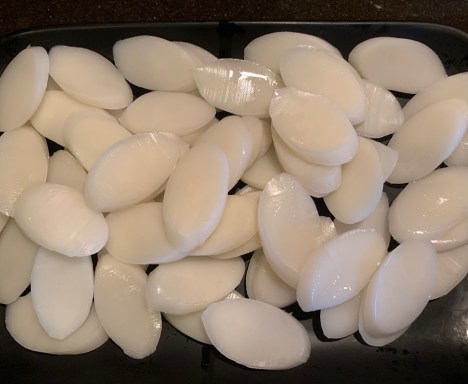
cover.JPGThis rice cake soup is delicious, comforting and very easy to make. It is perfect for a quick and hearty mid-week meal. Nian Gao (rice cakes), which means “higher every year”, is a squishy, sticky foodstuff made by pounding cooked rice with a wooden cudgel until smooth and elastic, then forming it into cakes that are sliced before cooking. They are chewy in texture, almost like a kind of noodle. Niao Gao comes with different shapes. The type of rice cakes for this recipe are white and shaped into flat ovals which you can find in most of the Asian supermarkets. I choose to use fresh, vacuum packed Korean rice cakes which can be used directly from the package.

Serve 3-4

Ingredients

For the meat & marinade:

  • 250g                    pork loin or chicken, cut into small, thin strips
  • 2 teaspoons       Chinese cooking wine (click here for homemade cooking wine)
  • 1 tablespoon       light soy sauce生抽
  • 1/2 teaspoon       sesame oil
  • 1/4 teaspoon       white ground peppercorn白胡椒粉
  • 1 teaspoon          corn starch

To assemble the soup:

  • 3 tablespoons                vegetable oil
  • 2 spring onions            thinly sliced on an angle, white and green parts separated
  • 1 small carrot, 80g,      thinly sliced
  • 400g                                napa cabbage, stems cut into ½-inch pieces and leaves cut into 1-inch pieces) 大白菜
  • 4 cups                              low sodium chicken stock (click chicken stock for homemade chicken stock)
  • 4 cups water
  • 1/2 teaspoon                 white ground peppercorn
  • 1 teaspoon                    sesame oil
  • 1 tablespoon                light soy sauce
  • 450g                                rice cakes 年糕IMG_3816.jpg

Instructions

  1. Combine the pork (or chicken) with Chinese cooking wine, light soy sauce, sesame oil, white ground peppercorn, corn starch, and water. Marinate for 15 to 20 minutes.
  2. Preheat your wok until it starts to smoke lightly. Over high heat, add 3 tablespoons oil, add white part of the spring onions, fry till fragrant, then add into pork until the meat strips turn pale and half-cooked.
  3. Reduce the heat to medium, add into the carrots. Cook for another minute and add the napa cabbage. Stir fry everything together for a few minutes until the napa cabbage leaves are wilted.
  4. Add 4 cups low sodium chicken stock and 4 cups water. Bring everything to a boil, then lower the heat and simmer for 5 minutes, until the thick stems of the napa cabbage are tender. Add salt to taste, ½ teaspoon white ground peppercorn, 1 teaspoon sesame oil, and 1 tablespoon light soy sauce.Sprinkle the rice cakes over the surface of the soup, along with green parts of the scallions. The rice cakes should be resting on top of the soup so they don’t sink into it and stick to the bottom of the wok/pot. Cover and cook for another minute, or as long as it takes to cook the rice cakes through (please see the Recipe Notes if you are using dried rice cakes). Salt to taste again and serve!

Notes

Since this recipe requires 8 cups of liquid, keep in mind you’ll need a large wok. If your wok isn’t big enough to accommodate the recipe, you can make it in a large, thick-bottomed pot.

The cooking time for rice cakes can vary based on brand, whether the rice cakes were fresh, frozen, or dried to begin with, and how thick or thin they were cut. Cooking time can be anywhere from 1-10 minutes. Fresh rice cakes cook in a minute or two. Frozen rice cakes can be thawed beforehand or thrown into the wok/pot frozen, though they may take an additional couple minutes. Dried rice cakes should be soaked overnight first and may also take a little longer to cook.


Chinese Pork Ribs with a Crust香酥肋排xiāng sū lèi pái

cover.jpgGive this healthy, hassel-free and oven-baked recipe a try, and crack open your favorite cold beer to go with it. They can be served as an appetizer, finger food, or as one of several main dishes. The marinade is simple and extremely flavorful. Panko are designed to soak up the marinade and provide a luxuriously crispy coating.

Serve 3-4

  • 1000g                      baby back ribs (cut into individual pieces; about 10-12 ribs, washed and pat dry with kitchen towel.)
  • 2 tablespoons          Chinese cooking wine (click for  homemade cooking wine)
  • ½ to 1 teaspoon       White peppercorn powder 白胡椒粉
  • 1 teaspoon                garlic powder or use 2 teaspoons of minced garlic
  • 2 teaspoons              caster sugar白糖
  • 2 tablespoons            light soy sauce
  • 1 tablespoon    corn starch
  • 1 egg
  • 1 and ½ cups            panko breadcrumbs
  • 1 and ½ teaspoons  coarse sea salt
  • Cilantro or chopped spring inions for garnish (optional)IMG_5900.jpg

Method

  1. In a large bowl, mix the ribs, Chinese cooking wine, white peppercorn powder, garlic powder, caster sugar, light soy sauce, corn starch and egg until combined. Toss in the ribs until they’re well coated and refrigerate overnight (if you’re scrambling for time, 2 hours will also suffice).
  2. When you’re ready to cook the ribs, preheat oven to 400F° or 200C°, and line a sheet pan with heavy duty foil for easy clean-up. Give the ribs another toss in the marinade.
  3. Mix the panko and salt in a separate bowl. Heavily dredge each rib in the panko mixture and place on the sheet pan. Sprinkle any of the remaining panko mixture on top of the ribs.
  4. Place the ribs in the middle of the oven, close the oven door, and immediately reduce the temperature to 325 F°. Bake for 30 minutes. Flip each rib and lightly cover them with a sheet of foil. Bake for another 30 minutes – this helps lock the moisture of the ribs. Remove the sheet of foil on the top and flip each rib again and turn up the oven to 400F° or 200C°, bake for another 10 minutes until the ribs become golden.
  5. Serve, garnished with cilantro or spring onions if desire


Cantonese Herb Pork Bone Soup广东猪骨例汤guǎng dōng zhū gǔ lì tāng

cover1

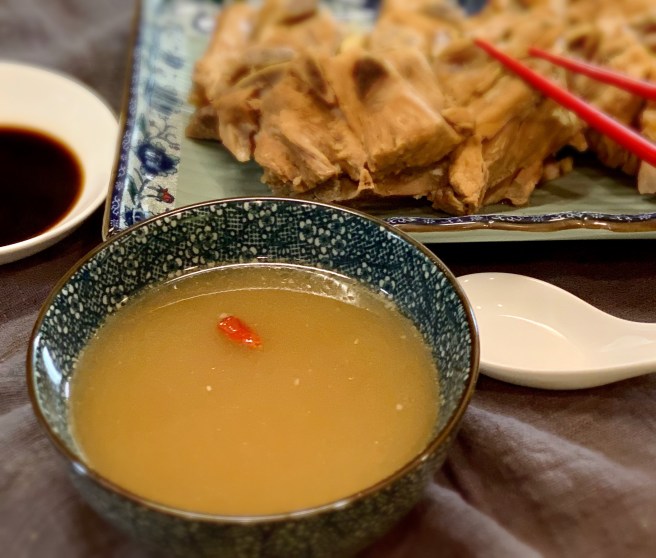
This hearty and nutritious soup will surely help keep you warm during the cold winter months. The meaty pork bones are so fragrant and delicious after hours of simmering. I always put extra in the soup and eat them with soy sauce on the side. Like any slow-cooked food, the soup tastes better on the second or third day. So feel free to make a large quantity if you wish.

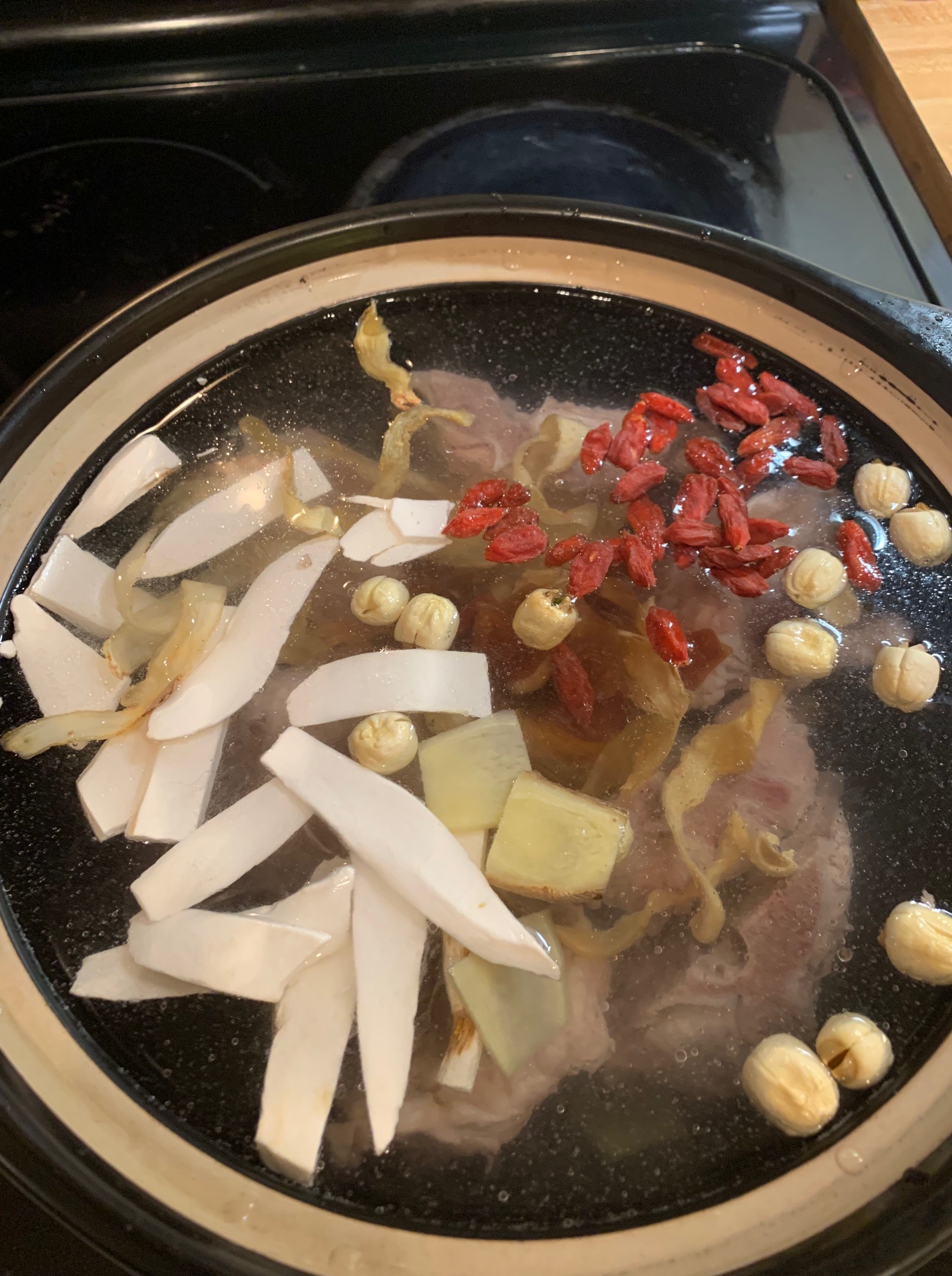
As you’ll see from the ingredients list, the rehydrated dried ingredients embody the essence of this soup. It’s worth mentioning that we prefer to only enjoy the soup stock while discard those rehrydrated dried ingredients after hours of cooking. The dried ingredients may sound daunting. If so, then look for the pre-packaged Cantonese Soup herb mix at your local Chinese grocery store. It’s definitely easier having everything in one package for your soup. That said, any pre-packaged soup mix varies in its ingredients so don’t be surprised if pre-packaged soups like the one pictured below are missing or have extra ingredients. You still will be able to achieve the same results.

The defining characteristic of Cantonese soup is its clarity. The soup might look clear, but it’s packed with flavours. To achieve this, the soup must be simmered low and slow throughout the cooking process. Too much boiling produces a cloudy soup.

Salt must be added right before serving. The key is to use less salt than normal, especially during the cooking process, in order to taste the sweetness of the soup itself.

Cantonese people like to add dried seafood, because it adds a lot of umami flavor to the soup, but it’s of course optional.

Serve 3-4

  • 750g           pork bones (try to find bones with more meat on them)
  • 4 slices       fresh ginger, cut ⅛-inch thick, 生姜
  • 30grams     dried Chinese yam (huái shān, 淮山or shān yào, 山药)
  • 25 grams    dried lotus seeds(lián zǐ, 莲子)
  • 10 grams    dried goji berries(gōu qǐ, 枸杞)
  • 15 grams     polygonatum odoratum(not sure if there’s a better English translation for this!) (yù zhú, 玉竹)
  • 10 grams    dried longan (guì yuán ròu, 桂圆肉)
  • 1 big dried honey dates (mì zǎo, 蜜枣)
  • 1 large piece of dried seafood, such as dried squid, dried abalone,and/or dried scallop (optional)
  • 2500 ml        cold water
  • Salt, to tasteIMG_5877

 Method

  1. Soak the pork bones in cold water for an hour. Rinse thoroughly and drain. The soaking process helps to get rid of any impurities or blood, to keep the soup clear.
  2. In a large stock pot, add the pork bones, and fill with enough cold water to fully submerge the pork bones. Turn up the heat and bring to a boil. Next, turn off the heat, dump everything into a colander, and rinse the pork bones clean. Wash the soup pot as well. This process will help to get rid of any remaining impurities in the pork bones to ensure a clear soup.
  3. Now put the pork bones back in the pot, and add the ginger, all of the dried ingredients, and 2500ml of cold water. Bring everything to a boil, and then immediately turn the heat down to simmer. Let the soup simmer for 3 to 4 hours.IMG_5878.jpg
  4. Before serving, skim off any fat from the surface of the soup.
  5. Salt to taste. Use a colander to remove all the rehydrated ingredients. Serve hot, along with some soy sauce on the table for dipping your pork into.


Chinese Air-dried Sausages 家常香肠jiā cháng xiāng cháng

coverStore-bought sausage can be good, and some are very good. But rarely are they as satisfying as those you can make at home, because you can adapt homemade sausage to your own tastes. You can use the nice cuts of meat as opposed to the butcher’s scraps. I have included two most popular types of flavors – non-spicy one and spicy (‘Sichuan Mala’) one.

I’d like to use the cut from the shoulder of the pig, above the front leg (which is called the picnic ham); also called pork shoulder, shoulder butt, or Boston butt. Pork shoulder is heavily marbled and inexpensive, and thus the perfect cut for sausage making. Be sure your sausage including at least 25-30 percent fat. If your pork shoulder meat is too lean, see if you can buy back fat from your local butcher or Chinese/Asian supermarkets. This is the layer of fat from the pig’s back, usually the purest white and thickest fat on the pig’s body. Don’t be afraid of fat. As matter of fact, fat is fundamental to the quality of a sausage, its succulence and flavour.

Temperature is important here too. As it dries naturally it the open air, there is only certain time of the year which is ideally for sausage-making. In China, people start the preparations of making sausages or other charcuterie-making around the winter solstice when the highest temperature won’t reach 10C°.

A very important food safety note – this air-dried sausage needs to be cooked before consumption. This is very different from other types of western -style air-dried sausages which you can eat raw. There are a couple of reasons for this – there is no food preservative (such as Nitrites which are commonly used for store-bought sausages.). Also we use commercially raised pork for these preparations instead of farm-raised hogs, animals raised out of doors by sustainable farms. To cook Chinese sausages, you can easily steam them over high heat for 20 – 30 minutes. Once they are cool off, then cut them into thin slices and eat them as appetizers. You can also cook them along with a pot of rice or use them in fried rice.

To store the sausages, place them in the fridge for up to 1 months and freezer for 3 months.

Basic ingredients (this can make around 20 Chinese sausages, each around 20cm long)

  • 2250 gram pork shoulder butt肩胛肉
  • 2 meters        natural hog casings 肠衣

You can choose one of the following two types of the seasonings. The seasoning recipes below are developed on the 2250 gram of the pork. If you decide to make both types of the sausages, just prepare a total of 4450g of the pork shoulder and 4 meters of the natural hog casings.

Seasonings for the non-spicy sausages

  • 67g         kosher salt, 3% of the quantity of the 2250 gram pork
  • 67g          rock sugar, well smashed, 3% of the quantity of the pork冰糖 (see the picture)
  • 45g         Chinese white spirit (“Bai Jiu’), 2% of the quantity of the pork中国白酒
  • 3g           ground white peppercorn白胡椒粉
  • 30g         light soy sauce

Seasonings for the spicy (Sichuan Mala) sausages

  • 67g              kosher salt, 3% of the quantity of the pork
  • 67g             chili pepper powder红辣椒粉
  • 5g                freshly ground Sichuan peppercorn现磨花椒粉
  • 67g               rock sugar, well smashed, 3% of the quantity of the pork冰糖
  • 67g               Chinese white spirit (“Bai Jiu’), 3% of the quantity of the pork中国白酒
  • 50g              dark soy sauce老抽

Equipment needed

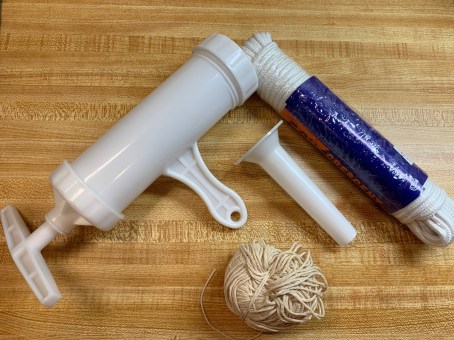
  • a special sausage stuffing tool or funnel and chopsticks for stuffing the sausages; toothpick or needle for pricking the sausages to release trapped air
  • Scissors and cotton lines for tying the sausages. And ropes for hanging the sausages.IMG_6596.jpg

Method

  1. No matter what flavor you prefer, wash the pork and pat dry with kitchen towel.
  2. Cut the pork into thin and large pieces (around 6 cm long and 4 cm wide with a thickness of 0.4cm to 0.5cm) or Simply cut them into small cubes (a little bigger than dice) if the nozzle of your funnel tube is small. Then add white spirit (Chinese Baijiu) and mix well. If you cannot find Chinese baijiu, use other alcohol (such as Vodka) to replace. Mix all the other seasonings. Mix salt, sugar and white pepper. Massage with hands and make sure all the ingredients are well combined. Then set aside for 30 minutes.
  3. Soak the casings in water for 20 minutes or until supple, or up to two days. Then hold them open beneath cold running water to rinse out the insides.
  4. Then set up the equipment and wrap the skin over the funnel tube. Or you can use a funnel and a chopstick as plunger. Tie one end and then cut off the remaining skin.
  5. The equipment I use is somewhat like a semi-automatic plunger. The pork meat is pushed ahead when pushing down the plunger. If you do not have this equipment, use chopstick or wood stick to push the pork into the skin.
  6. Once finished, use a cotton line (around 10cm to 12 cm long) to tie and divide the sausage into small sections around 20cm long, so we can continue hanging and drying process.IMG_6611
  7. Pat dry with kitchen towel, then hang and dry. Use a small needle to prick the sausages to release trapped air. Left them dry in the open air for about 14 days or they’ve lost about 30% of the total weight. Dry under the sun is good. But try to avoid direct sun at all times because your sausages will become very dry. Touch is fairly reliable means of judging the doneness of sausages. Squeeze the sausages: it should feel stiff, almost hard, all the way through to the center.
  8. To cook Chinese sausages, you can easily steam them over high heat for 25 – 30 minutes. Once they are cool off, then cut them into thin slices and eat them as appetizers. You can also cook them along with a pot of rice or use them in fried rice.